Thanks @emmanuel for appreciating how unsettling the last 48 hours have been for people who have staked their livelihoods on Bubble.
As well as being scared about the future, many of us continue to recognise how one of the reasons we love Bubble is how engaged you, Josh and the team are with the community.
There are no “different points” Emmanuel, I am sorry. There is a big elephant in the room that you are failing to address. 99% of your customers are appalled by the new pricing change and many of them (including the veterans) also put in doubt the structure. Nevertheless, you dismiss all that with a single sentence. Do you even take into consideration the data and other people’s opinions? How and why did the bubble team came up with this pricing policy? These are all questions that imo you would have to answer at this point.
All this has been PR disaster and your subsequent actions have failed to give any assurance to the community. I personally am exhausted. I won’t comment any more here. Thank you.
The concept of usage-based pricing is excellent. Many major players in the market follow this model, such as:
Zapier and n8n, which charge for the number of workflows; Make, which charges for executed actions; AWS, which uses “execution time”; and Cloudflare, which charges based on invocations. This approach works well.
Additionally, some companies build on top of these services, like Vercel, which uses Cloudflare and charges five times more while providing a fantastic developer experience.
However, Bubble recently introduced Workload Units (WUs), a black box algorithm that is not transparent, and users do not understand how it is measured. Tests have indicated that the same actions do not consistently produce the same WUs, even under identical conditions. I understand that Bubble needs to charge a premium on top of AWS but saying something would cost 0.5-3 WU while its 5-25 WU is just not right.
This lack of transparency means that users must completely trust Bubble, which has become difficult due to discrepancies between the VP of Marketing’s statements and the actual WUs observed by users within Bubble. Even if Bubble decided to increase WUs tenfold for all plans, this trust issue would remain.
While it is possible to measure and trust metrics like the number of Zapier calls, Make actions, or Cloudflare invocations, trusting a black box algorithm like WUs is challenging.
To regain user trust, I would recommend that Bubble hire an external auditor to monitor and verify how WUs are measured. This would ensure transparency and honesty in WU calculations, helping to rebuild the trust that has been lost.
We are already in the beginning of Q2. So it’s very important for us to know if we may or may not see noticeable improvements in bulk data operations speed and workload consumption.
From May 1st we will have a dilemma:
Urgently start transition of our/clients apps to another platform
Continue developing apps on Bubble in the hope that we will see breaking change in Q3 that will significantly reduce the bill. If not - we will just loose 6 months for nothing and only 12 months will be left to transit apps to another platforms.
From my point of view new pricing model should not be rolled out until Bubble team fixes all that stuff with bulk operations and other WU expensive things (as it has been mentioned for a lot of times here - in some cases we have to make expensive WFs cause there is no other options in vanilla Bubble). While Bubble is working hard to deliver this - we are playing with workload and trying to optimise our apps.
Only when Bubble will introduce promised noticeable improvements - new pricing model should be released for new apps and XX-months legacy period for existing apps should be announced.
Upon termination of rights or access for any reason, all licensed rights granted under the Agreement, access to the Noodl Service, and Support Services will be terminated, and you must cease all use and destroy all copies of the Noodl Software.
This was one of Bubble’s strengths, they claim in their terms if Bubble was to become insolvent, they’d release the code as open source (or make available)
@emmanuel jumping back in to say that this is even more disgusting.
Queue my rant:
The fact that you guys had over a YEAR to plan, research, and develop something that would work was supposed to be your sole focus for the future of Bubble, and you still have not been able to deliver.
The industry standard for price increases is not 20x. It’s been currently 5-10% (which is fine, and I’m sure most would agree).
There’s no excuse for not being ready for game day. The fact that the metrics are completely off. The fact that there was no calculator or equivalent to truly understand what the cost increase was or how it’ll affect apps. The fact that you had a VP of marketing cover smoke for you while you and your team took the weekend off, is just wrong.
I hope you guys get your shit together, clean house, rethink your morals/values/mission statement, and maybe, just maybe, you can retain some of your user base going forward.
I say all this as a passionate (now former) Bubbler who had all the best for Bubble. Who preached Bubble to others and my company!!! You should be ashamed. I’m not sure how this doesn’t go against the Fair Act. Perhaps arbitration is needed.
Regardless if you fix the metrics, your trust is just completely lost with your COMMUNITY BUILT PLATFORM.
Hey @gaimed while I agree with the spirit of what you’re saying, what I’m finding in general is that it’s not so much how WUs are calculated, it’s that the markup over the commodity price in insane.
The app I’ve been talking about (and similar apps that make calls to API endpoints) seems to be pretty consistent in the WUs it generates for those calls, but the billed price is outrageous (something that costs 3 pennies per month on the GCF side, Bubble wants to charge me about $300 for). That’s a non-starter.
Similarly, my findings about SSAs are even worse. A 45,000X markup on an AWS Lambda execution. Uh, no. Just no.
The usage based direction isn’t the issue, nor is it the certain parts that cost too much. It’s the LOW WU that makes even more simple apps 2-30x in price when they weren’t breaking 10% capacity. It’s the fact that using external databases from the looks of it won’t be possible under the pricing model except for those with funding, which anyone with funding shouldn’t build on bubble after the multiple times trust has been broken with the whole community.
No one had an issue with a price increase but to these levels is unheard of from most large scale apps. It’s caused distrust in the no code community as a whole.
Bubble is a private venture with funding however community driven in many ways. Countless apps wouldn’t exist if plugin builders & template builders weren’t around to help people overcome bubbles lack of functionality & jumpstart their apps. I don’t quite understand how bubble can ethically or even from a business standpoint make a move that so greatly effects the entire community that the platform is built on.
The price hikes to the extent displayed in the forum that are many multiples above any competition of bubbles makes MVP builders, bootstrapped startups, and any non funded startup near impossible for them to launch here and if I’m not mistaken from the beginning bubbles mission has been to create a product for those people.
That was last year’s solution… They said they’d listen to their user base, they didn’t. I was invited to answer a few of the initial surveys on what needs to be done like your saying…
Even the surveys were aiming at a specific point. I had to find places (fields not really used for feedback) to actually say what I thought because from the beginning they had only one possible outcome in mind.
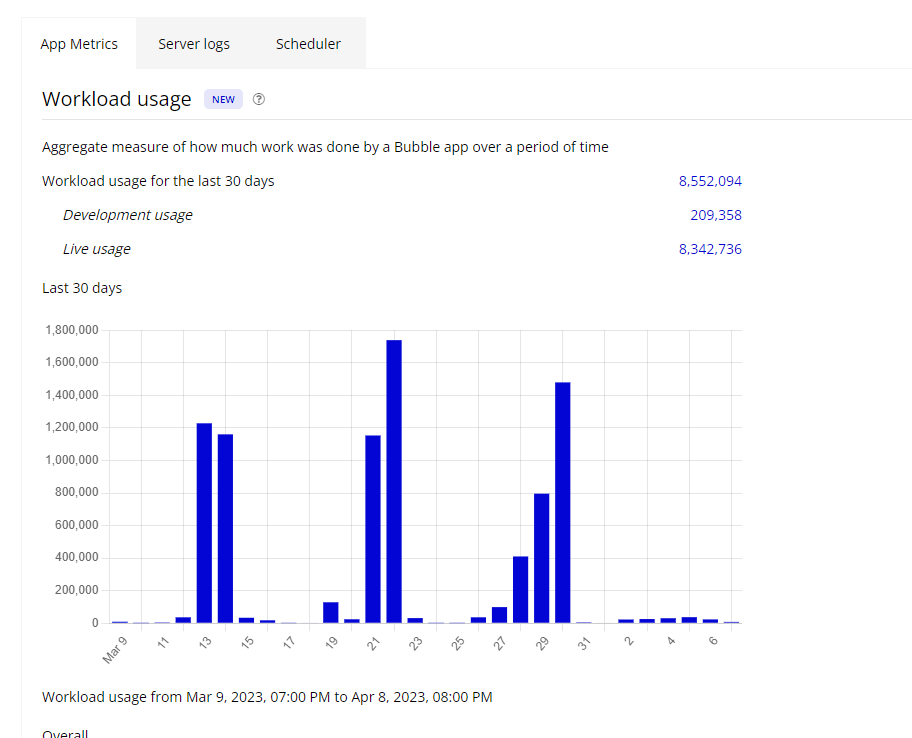
Open DevTools, go to Network tab, and flick “Frech/XHR” on the third row down to filter out other things. In the list, look for “get_daily_compute_usage” and “get_workload_usage_breakdown”, then click on Response tab to see the data
If bubble is indeed marking up compute cost by 10000x to 100000x they are going to lose.
It’s so obvious.
If you want to capture the revenue of the big winners, you can’t offer them this a huge opportunity to switch to AWS once the concept is validated.
Really odd leadership with every announcement and update. At this point it’s hard to feel confident in the bubble leadership, even if the pricing is updated. The tool itself is phenomenal but it will become a commodity if Bubble has erratic management that will exponentially increase pricing for existing apps on a moment’s notice.
It’s not so long until you can give GPT5 a list of workflow options, conditional design options, etc, and spit out a Bubble competitor.
Bubble’s key innovation is its modular design but that’s exactly why a 10,000x markup on compute can never work for them. People can and will move away, and the biggest winners will have the highest incentive to do so.