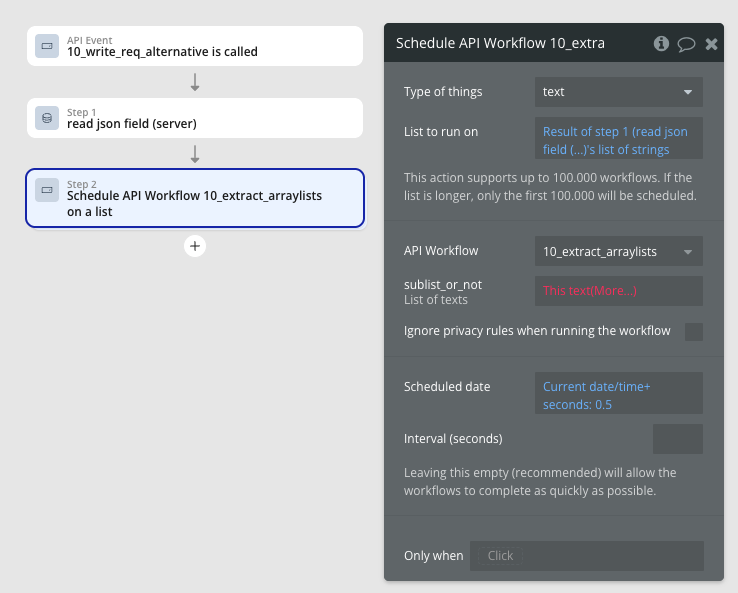
In the screenshot you see that I input a JSON list > extract the nested lists in Step 1 > hand them over to an API Workflow on a list > but bubble now does not accept that “this text” is actually a list!
Do you know this problem? Is there any trick to it?
Add a “split by” operation after “This text” and type in the delimiter that’s used to separate the lists in “This text” (likely a comma?).
Bubble doesn’t know “This text” is another list. It’s seeing it as a single text, and the “split by” operation will convert it to a list format as long as you have a consistent delimiter.
But be careful in case the content inside a list also has commas…
This would normally be caused by a formatting issue on the incoming JSON. If the structure is correctly formatted and pushed to bubble correctly (e.g. via detecting request data on an API workflow, or making sure your API connector call is outputting JSON), bubble would recognise arrays and nested arrays as such, regardless of the number of entries inside them.
If you are only getting a plaintext payload from the API you are using, you could forward that data on to one of your own backend workflows via the API connector, which would result in bubble correctly treating your payload as a JSON object.
Created a new data type or used the existing data type that contains the outer list.
Created a “list of” field on this data type, and save the inner list in this “list of” field.
In the Schedule API Workflow on a list action, use the outer list data type as your type of things, and search this data type to retrieve the list to process.
Hello everyone and thank you again for your answers!
After a lot of trial and errors, I could solve it by manually creating my own recursive backend workflow “on a list”. A big learning to build the loop myself.
It works excellent for me when a condition must be true for another condition to run, I found. By having the controll of each step the workflow can be controlled far more precisly. At the same time the values don’t get mixed up so easily.
But of course it’s paid by speed, because of the sequentiallity.
If anyone wants to know more of the details - happy to share.