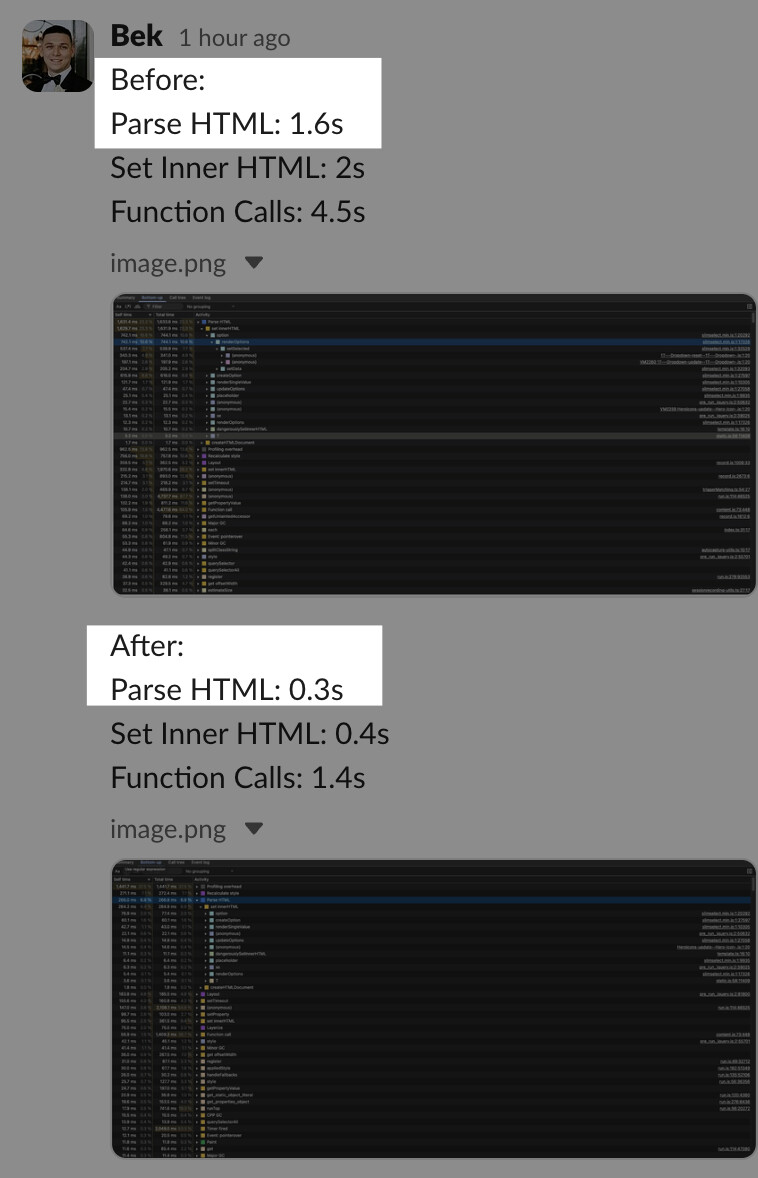
That just gave me a ton of homework.
Is this not something that Bubble’s engineers should be doing instead of us? I don’t see how it would be possible to fix any issues identified by this (other than plugins).
Yep true. Plugin builders that rely on DOM manipulation will benefit the most.
Still a good opportunity to see where Bubble can improve. They really should start bug bounties.
A useful snippet to monitor memory usage:
window.memoryMonitorInterval = setInterval(() => {
  if (performance.memory) {
    console.log({
      used: Math.round(performance.memory.usedJSHeapSize / 1048576) + ' MB',
      total: Math.round(performance.memory.totalJSHeapSize / 1048576) + ' MB',
      limit: Math.round(performance.memory.jsHeapSizeLimit / 1048576) + ' MB'
    });
  }
}, 5000);
I really wish Bubble would do this with their editor.  Sometimes Bubble is unusable with very large applications. Just the editor. Not the application.
This reminds me of Tom Cruise in the beginning of Days of Thunder. The more knowledgeable you are about the thing you’re driving, the better you will be at driving.
I agree with this in principle but so many of Bubble’s choices are frustrating that, in this case, ignorance truly is bliss.
I’m fairly certain this has been the case for the past decade or so with the Editor and large pages, REs structures. Especially, I believe SPAs that can have thousands of elements, and by adding some plugins on top, it will become a nightmare to load. (Saw some crazy development sh*t in some apps)
I wish there were an Offline Editor with local data containing everything a developer is working on. Then, the developer signs in online, and the editor syncs with the servers to update the changes to the latest version.
You’re describing Fluxscape (née Noodl). 
Ooohhh… I guess. 
Soooo I’ve heard something about Noodl. I believe in the past, once the Low Coders kicked in. But the Fluxscape is new to me.
A quick search shows that it is a fork of Noodl.
Well, if someone can do it, I’m pretty sure Bubble can as well. But yeah, the resources and priorities for the end of the year are on a different plate. 
El @bek taking it to the next level
What’s the implication? How can an end user achieve this?
By user you mean developer.
This was a particular case of a dropdown plugin doing re-rendering too eagerly. 2 solutions:
OK, I thought it would be something different from this:
Just fork the plugin or build it yourself? Most plugin code is so obviously bad that you can just identify issues and fix it with any frontier LLM model.
Inspecting memory is such an unnecessarily low level process for something like this (YMMV).
Memory inspection should not be your everyday activity, I agree.
It is a valuable tool to have on your tool belt. In this case was related to a plugin, but it could just as well be related to a Bubble element that the developer could be misusing.
You got a point. I updated the title.